
If your mortgage quote has jumped, your fuel bill keeps creeping up, or your business loan suddenly costs more to service, you are not imagining it. The world is living through a period in which debt is at record highs and money has become more expensive to borrow, both at the same time.
The headlines talk about bond yields and budget deficits, which can feel a long way from everyday life. But the same forces squeezing governments are landing on kitchen tables and company balance sheets. This guide explains the global debt crisis in plain English and, more importantly, what you can do about it.
Key numbers at a glance
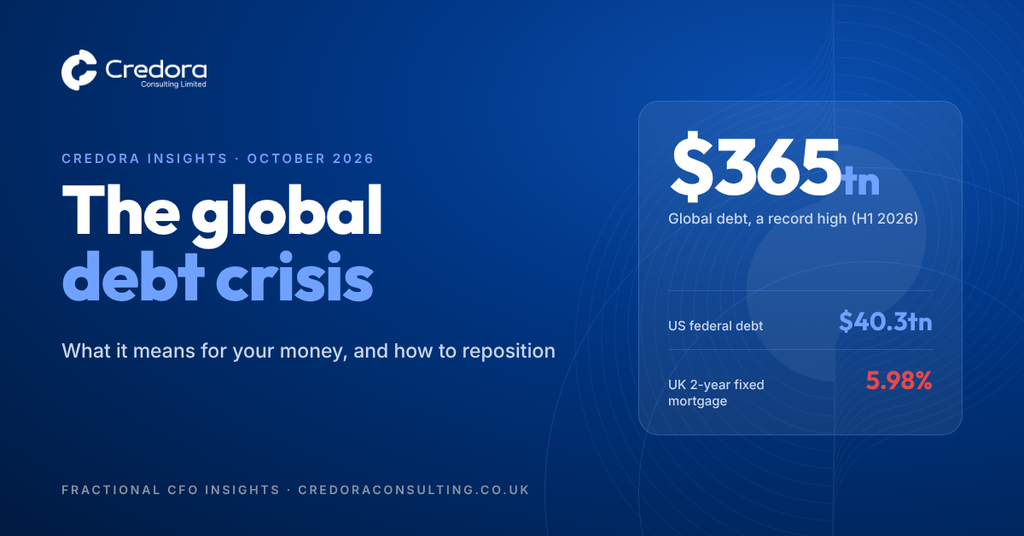
$365 trillion
total global debt in the first half of 2026, a record high
$40.3 trillion
US federal debt in mid-October 2026, roughly $118,000 for every person
$3.3 trillion
what advanced economies spent last year just servicing their government bonds
5.98%
the average UK two-year fixed mortgage rate in early October 2026, up from 4.84% in March
7.13%
the average UK standard variable rate in October 2026, where borrowers drift if a fixed deal ends
5.3%
the US 10-year Treasury yield after September’s inflation figures, near a 24-year high
3.1%
UK inflation in August, with the Bank of England expecting slightly above 4% in early 2027
The global debt crisis in numbers
Debt is not a problem in itself. Governments, businesses and families all borrow to invest, to smooth out spending and to get through hard times. The concern today is the sheer scale of it, and how quickly the cost of carrying it is rising.
- Global debt: The Institute of International Finance (IIF) reports that total global debt, covering governments, companies, households and the financial sector, passed a record $365 trillion in the first half of 2026, rising by more than $10 trillion in just six months.
- United States: US federal debt crossed $40 trillion for the first time in August 2026 and stood at around $40.3 trillion in mid-October, according to US Treasury data. That works out at roughly $118,000 for every person in the country.
- France: French public debt reached €3.6 trillion, about 119% of GDP, in the second quarter of 2026, according to the national statistics office INSEE. The deficit is running at around 5.4% of GDP, well above the EU’s 3% reference value, and the government expects its annual interest bill to rise from €79.2 billion in 2026 to €91.2 billion in 2027.
- The cost of carrying it: Advanced economies spent more than $3.3 trillion last year servicing their government bonds, according to IIF data reported by CNBC. That is more than the world spends on AI, defence or clean energy individually.
France is a useful illustration of how this plays out. BNP Paribas economist Stéphane Colliac notes that the country missed its budget targets in three of the four years between 2023 and 2026, and a succession of prime ministers have struggled to pass spending cuts and tax rises. Each failed attempt makes lenders a little more nervous, and nervous lenders charge more.
Why lenders are demanding higher returns
Imagine lending money to two friends. One has a steady job and always pays you back on time. The other already owes money to several people and keeps promising to sort out their finances next month. If you lend to the second friend at all, you would want something extra for taking the risk.
Bond investors think the same way. When a government’s debt keeps growing and its plans to control it look shaky, investors demand a higher yield, which is the return they receive for lending. The same logic applies to companies: a business with a weaker balance sheet pays a higher interest rate than a stronger competitor. That repricing is exactly what has happened in 2026:
- France: the 10-year government borrowing cost briefly touched 5% at the start of October 2026, its highest level since 2002, and its premium over Germany has widened to levels last seen in the eurozone debt crisis of 2011-12.
- United States: the 10-year Treasury yield climbed to about 5.3% after September’s inflation figures, having touched a 24-year high of 5.365%, before slipping back to around 5.1% in the days that followed.
- Elsewhere: bond yields in the UK and Japan have also risen to their highest levels in more than a decade.
Why this matters to you: government bond yields act as the foundation for many other interest rates. When they rise, the cost of fixed-rate mortgages, business loans and car finance usually follows.
Wars, energy and inflation: why rates are not coming down
Just as debt was reaching record levels, conflict pushed up the cost of living again. The war involving the US, Israel and Iran, which began at the end of February 2026, has disrupted oil shipments through the Strait of Hormuz, while the war in Ukraine continues to weigh on European energy and food markets. The knock-on effects have been significant:
- Energy: Brent crude reached around $106 a barrel in mid-September, and UK wholesale gas prices rose 78% between the Bank of England’s July and September forecasts.
- US prices: inflation rose to 3.7% in September 2026, with petrol prices accounting for about half of the monthly increase. The average US price at the pump hit a monthly record of $4.33 a gallon in September, roughly 45% above its pre-war level.
- UK prices: inflation rose to 3.1% in August, and the Bank of England expects it to reach slightly above 4% in early 2027.
This leaves central banks in a bind. Normally, when growth slows, they cut interest rates to help. With inflation rising, cutting could make prices climb even faster. The US Federal Reserve raised rates in September 2026 for the first time since 2023, and three of the nine members of the Bank of England’s rate-setting committee voted for an increase the same month.
The message for borrowers: do not build your plans around cheap money returning any time soon.
How the debt crisis reaches your kitchen table
For households
You do not need to own a single government bond to feel the effects. The pressure tends to show up in three ways:
- Higher mortgage costs. In the UK, the average two-year fixed mortgage rate reached 5.98% in early October 2026, up from 4.84% in March, according to Moneyfacts. On a £250,000 mortgage over 25 years, a rise of that size adds around £170 a month, or roughly £2,000 a year.
- Pricier everyday essentials. Fuel, energy and transport costs feed into the price of almost everything, from groceries to flights. Moody’s Analytics chief economist Mark Zandi estimates the war has cost the average US household almost $2,000 so far, including about $1,100 in higher energy costs and $540 in higher interest rates.
- More expensive credit. US credit card balances reached $1.26 trillion in mid-2026, close to a record high, and roughly one in every eight dollars of card debt is seriously past due, according to the Federal Reserve Bank of New York.
For businesses
Companies face a similar squeeze, just with more zeros. Loans taken out when interest rates were close to zero are now being refinanced at much higher rates. At the same time, materials, energy and transport cost more, and staff understandably want pay rises that keep pace with prices. A business that was comfortably profitable three years ago can find its margins squeezed from every direction at once.
For business owners, the pressure tends to show up in four places:
- Refinancing deadlines. Facilities agreed when money was cheap are coming up for renewal, often at rates several percentage points higher. Leaving it late reduces your bargaining power.
- Lender covenants. Many business loans require you to keep profits comfortably above interest costs. Higher rates and thinner margins can push a healthy business close to a breach without warning.
- Cash-flow gaps. When customers are squeezed too, they pay later. Even a profitable business can run short of cash if invoices slip by a few weeks.
- The true cost of debt. The headline rate is only part of the picture. Fees, tax treatment and the timing of repayments all change what borrowing really costs.
The real lesson: debt is a tool, not a strategy
It is tempting to conclude that all debt is bad. It is not. Used well, debt is one of the most powerful tools available to families and businesses alike. The trouble starts when there is too much of it, or when it is used for the wrong purpose.
Why sensible debt can work in your favour
For businesses, interest is generally tax-deductible, whereas dividends paid to shareholders are not. Finance professionals call this the ‘tax shield’. As a simple example, a UK company paying the 25% main rate of corporation tax that borrows £1 million at 7% pays £70,000 a year in interest, but could reduce its tax bill by up to £17,500, bringing the effective cost of the loan closer to 5.25%.
Conditions to know: rules such as the UK’s corporate interest restriction and US limits on interest deductions can cap this benefit for larger borrowers, so it is worth taking advice on your own position. For business owners, this is exactly the kind of question a Fractional CFO can model before you commit to new borrowing.
Debt also allows you to do things now that pay off over time: buying a home, training for a better-paid career, or investing in equipment that makes a business more productive.
When debt turns dangerous
Those benefits disappear when borrowing grows beyond what your income can comfortably support. A helpful rule of thumb is to match the debt to what it pays for:
- Long-term debt for long-term value. A 25-year mortgage on a home you plan to live in for decades, or a five-year loan for machinery that will last ten years, makes sense.
- Short-term debt for short-term needs. An overdraft to bridge the gap until customers pay their invoices is reasonable. Using it to fund a long-term expansion is not.
- Avoid borrowing for day-to-day spending. Putting regular bills or groceries on a credit card you cannot clear each month is one of the quickest routes into a debt spiral.
When debt swallows a successful company
History is full of businesses with loyal customers and well-known brands that were brought down by their balance sheets rather than their products. Toys ‘R’ Us was a household name, but after a 2005 leveraged buyout it was left carrying around $5 billion of debt and spending roughly $400 million a year on interest, money that could have modernised its stores and website. It filed for bankruptcy in 2017. China’s property giant Evergrande, which built homes for millions of people, ran up liabilities of more than $300 billion before a Hong Kong court ordered it to be wound up in January 2024.
The lesson holds at every scale: debt is not fatal on its own, but excessive debt removes your margin for error. When conditions change, as they have in 2026, the most heavily indebted are the first to struggle.
How to reposition your finances for this era
The theme for both personal and business finances right now is moderation. Here are practical steps, depending on where you are.
For individuals and families
- Know your numbers. List every debt you have, its interest rate and the date any fixed deal ends. Many people are surprised by the total once it is written down in one place.
- Clear the most expensive debt first. Credit and store cards often charge more than 20% a year. Paying off a £5,000 card balance charging 24% saves roughly £1,200 a year in interest, a guaranteed return that few investments can match.
- Repay capital, not just interest. Where you can, choose repayment over interest-only borrowing. Paying down the amount you owe gradually reduces your exposure if rates keep rising.
- Plan your mortgage renewal early. UK lenders typically let you secure a new deal up to six months before your current one ends. Drifting onto a standard variable rate, which averaged 7.13% in October 2026, can be very costly.
- Build a cash buffer. A rainy-day fund covering three to six months of essential spending means an unexpected bill does not end up on a credit card.
- Think twice before borrowing for things that lose value. Financing a new car or holiday at today’s rates deserves careful thought.
For business owners
- Stress-test your debt. Ask what happens to your cash flow if rates rise by another one or two percentage points, or if a major customer pays late.
- Repay steadily rather than relying on refinancing. Loans with a large final ‘balloon’ payment depend on lenders being willing to refinance, which is not guaranteed in a tighter market.
- Use more equity for growth. Funding expansion through equity, such as bringing in investors or partners or reinvesting profits, means no fixed repayments when trading gets tough. You give up a share of future profits, but you gain resilience.
- Match funding to purpose. Use long-term finance for long-term assets and keep short-term facilities for working capital.
- Keep an eye on energy-linked costs. Review contracts for fuel, transport and utilities, and consider fixing prices where it makes sense.
Where a Fractional CFO helps: most owners know they should be doing this, but few have the time or in-house expertise to do it well. A Fractional CFO keeps your forecasts current, models the impact of rate rises before they arrive and makes sure financing decisions support the business rather than strain it.
Practical scenarios
Scenario 1: The homeowner coming off a cheap fix
Amara fixed her £200,000 mortgage at 1.9% in 2021, and her deal ends in early 2027. With average fixed rates now close to 6%, her monthly payment could rise by several hundred pounds.
What she does: rather than wait, she starts comparing deals six months early, uses some savings to overpay before the fix ends (staying within her lender’s overpayment allowance), and clears a £3,000 credit card balance to strengthen her application. She cannot control interest rates, but she can control how prepared she is.
Scenario 2: The small business ready to grow
David runs a local delivery firm and wants three new vans. A few years ago he would have borrowed the full amount. Today, with higher rates and fuel costs, he works through the decision with a Fractional CFO, who models the cash-flow impact of each funding option and stress-tests the repayments against a further rise in rates.
The result: together they settle on a mix. He finances one van with a five-year loan that matches its working life, pays for the second from retained profits, and brings in a minority investor for the third in exchange for a small share of the business. His repayments stay manageable, and he keeps a cash cushion in case fuel prices climb further.
Frequently asked questions
Is a debt crisis the same as a recession?
No. A debt crisis describes borrowers, often governments, struggling to service or refinance what they owe. It can contribute to a recession by pushing up borrowing costs and forcing spending cuts, but one does not automatically cause the other.
Will interest rates come down soon?
Nobody can say for certain. Much depends on energy prices and how long the conflict in the Middle East lasts. In mid-October 2026, UK financial markets were pricing in several rate rises by the end of 2027 rather than cuts. Planning for rates to stay higher for longer is the prudent approach.
Should I pay off debt or save?
Usually a bit of both. Build a small emergency fund first so you are not forced to borrow again, then direct spare money at your most expensive debt. If your debt costs more in interest than your savings earn, paying it down normally comes out ahead.
Is now a bad time to borrow?
Not necessarily. Borrowing can still make sense for something that creates long-term value, provided the repayments remain affordable even if rates rise further. It is a poor time to borrow for spending you could put off.
Does my business need a CFO if I already have an accountant?
Often, yes. An accountant typically focuses on compliance: preparing accounts, filing tax returns and keeping you on the right side of the rules. A CFO looks forward, building forecasts, managing cash flow, negotiating with lenders and helping you decide how to fund growth. A Fractional CFO provides that strategic support part-time, so you get the expertise without the salary of a full-time hire.
Key takeaways
- Global debt is at a record high, and the cost of servicing it is rising for governments, businesses and households.
- Lenders are charging more because the risks look greater, and war-driven inflation is keeping interest rates elevated.
- Debt remains a useful tool when it is affordable, matched to its purpose and used to build long-term value.
- Now is the time for moderation: repay capital gradually, tackle expensive debt first, build a cash buffer and consider equity to fund growth.
- For business owners, visibility is everything. Stress-test your debt, plan refinancing early and make sure someone is looking ahead at your numbers, whether that is an in-house finance lead or a Fractional CFO.
Related reading: How to Reduce Your Company’s Tax Bill Legally in the UK
How Credora can help
Credora’s Fractional CFO service gives growing businesses senior financial oversight on a flexible basis, without the cost of a full-time finance director. We help you:
- stress-test your debt against further rate rises
- plan refinancing well ahead of deadlines
- forecast cash flow so there are no surprises
- decide how to fund growth, whether through debt, equity or retained profits
Is your business ready for higher-for-longer rates?
Book a free debt and cash-flow health check with Credora, and plan your next move before rates move again.
Or email us at enquiries@credoraconsulting.co.uk
Important information: This article is published by Credora for general information and educational purposes only. It does not constitute financial, investment, tax or legal advice, and it does not take into account your personal circumstances, objectives or needs. Figures are drawn from the sources listed below and were believed to be accurate as of October 2026; economic conditions, interest rates and tax rules can change quickly. Examples and scenarios are illustrative only. Before making decisions about borrowing, repaying debt, investing or raising finance, please speak to a qualified, regulated professional. If you are struggling with debt, contact a free debt advice service. The value of investments can fall as well as rise, and past performance is not a reliable guide to future results.
Sources: Institute of International Finance, Global Debt Monitor (September 2026); US Department of the Treasury, Fiscal Data: Debt to the Penny (October 2026); INSEE and French Ministry of Finance data, as reported by Euronews and CNBC (September-October 2026); Bruegel, analysis of French public finances (October 2026); Bank of England, Monetary Policy Summary and Minutes (September 2026); Office for National Statistics, Consumer Price Inflation (August 2026); US Bureau of Labor Statistics, Consumer Price Index (September 2026); Federal Reserve Bank of New York, Quarterly Report on Household Debt and Credit (Q2 2026); Moneyfacts, UK mortgage rate data (September-October 2026); Moody’s Analytics (Mark Zandi) and AAA fuel price data, as reported by the Associated Press (October 2026).