
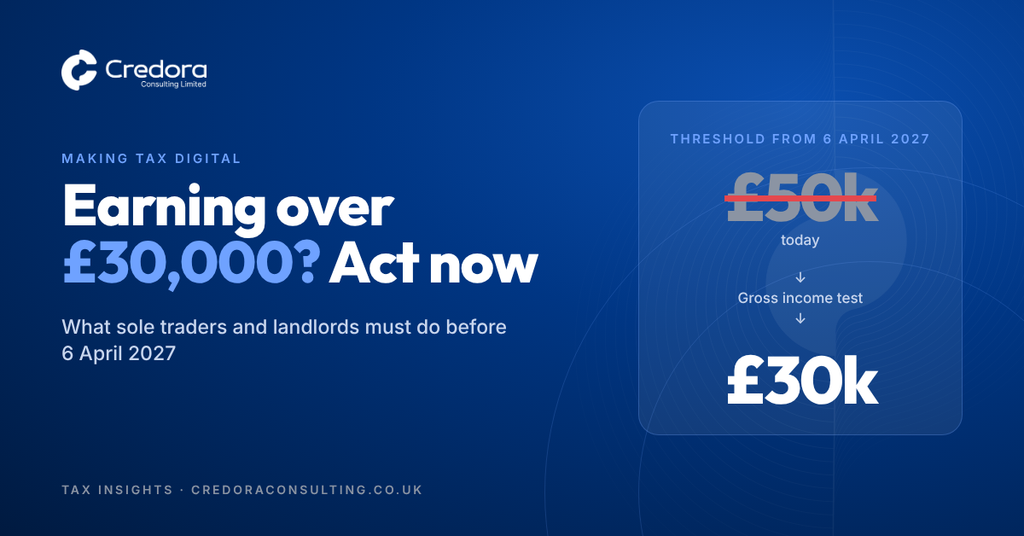
On 5 October 2026, HMRC reminded sole traders and landlords that Making Tax Digital for Income Tax is about six months away for the next wave of people. From 6 April 2027, anyone with self-employment and property income above £30,000 will have to keep digital records and send HMRC updates through approved software, instead of filing one return a year. HMRC estimates around 1,077,000 more people will need to join.
If you are a sole trader or landlord with income near or above £30,000, the time to prepare is now. This guide to Making Tax Digital for sole traders and landlords explains who is affected, how the £30,000 test works, what you will have to do, and a simple countdown to April 2027.
[VIDEO: delete this line and paste the YouTube link for this article’s video here, on its own line. WordPress will turn it into the video player automatically.]
Key numbers at a glance
What is Making Tax Digital for Income Tax?
Making Tax Digital (MTD) for Income Tax changes how sole traders and landlords report to HMRC. Instead of gathering a year of paperwork before the deadline, you keep your records digitally throughout the year and send short updates every three months.
The rules already apply to anyone with qualifying income above £50,000 from 6 April 2026. The next step is below.
| Start date | Who must join | Income test |
|---|---|---|
| 6 April 2026 | Sole traders and landlords | Over £50,000 |
| 6 April 2027 | Sole traders and landlords | Over £30,000 |
| 6 April 2028 | Sole traders and landlords | Over £20,000 |
Are you affected? How the £30,000 test works
- It is about gross income, not profit. The test uses your self-employment and property income before expenses are taken off. HMRC calls this turnover.
- Self-employment and property income are added together. A landlord with a side business counts both.
- The 2025/26 tax year decides. For April 2027, the figure comes from your 2025/26 Self Assessment return, which you file by 31 January 2027.
- Jointly owned property: each owner counts their own share of the income.
- Partnerships are not included yet. Partnership profit share does not count towards the test, and the government has said it will bring partnerships in later.
What you will have to do
- Keep digital records of income and expenses, using compatible software.
- Send four quarterly updates a year. These are short summaries of your income and expenses, not extra tax returns. Send one for each income source, such as self-employment and property.
- Complete your tax return in the same software after the tax year ends. The deadline stays at 31 January after the year end.
Quarterly update dates for the first year
For the 2027/28 tax year, updates are due on these dates:
| Period covered | Update due |
|---|---|
| 6 April to 5 July 2027 | 7 August 2027 |
| 6 July to 5 October 2027 | 7 November 2027 |
| 6 October 2027 to 5 January 2028 | 7 February 2028 |
| 6 January to 5 April 2028 | 7 May 2028 |
Software and spreadsheets
- HMRC does not provide its own software. You choose from products on its list of compatible software on GOV.UK, and free options exist for simpler businesses.
- Spreadsheets can still be used alongside bridging software that sends the figures to HMRC, but you cannot copy and paste data between systems by hand. Digital links are required.
- Choose software built for Income Tax. MTD for VAT and MTD for Income Tax are separate services, so VAT software may not cover both.
What happens if you miss a deadline?
Penalties for late quarterly updates work on a points system.
- One point for each missed quarterly update or tax return deadline.
- Four points bring a £200 penalty, and a further £200 for each later missed deadline.
- Points expire after 24 months if you stay below the threshold. At the threshold, you need 12 months of on-time submissions to reset.
- No penalty points apply to quarterly updates for the 2026/27 tax year, but that relief covers the first wave. For people joining in April 2027, points apply from the 2027/28 tax year.
Your countdown to April 2027
- Now: work out your gross 2025/26 self-employment and property income and see how close you are to £30,000.
- November to December 2026: choose MTD-compatible software and move your records into it.
- By 31 January 2027: file your 2025/26 Self Assessment return. It is the one that decides whether you are in.
- By March 2027: sign up on GOV.UK. HMRC says signing up early lets you check your details and choose software in your own time. You must be registered for Self Assessment and have filed a return in the last two years.
- 6 April 2027: start keeping digital records for 2027/28.
- 7 August 2027: send your first quarterly update.
Practical scenarios
Scenario 1: The sole trader whose profit hides the answer
Priya runs a small design business. In 2025/26 she billed £34,000 and spent £9,000 on software, travel and subcontractors, leaving a £25,000 profit.
The result: her turnover is above £30,000, so she will need to join from 6 April 2027, even though her profit is well below it.
Scenario 2: The landlord with a side income
Tunde has two rental flats bringing in £27,000 a year and earns £4,500 from freelance work.
The result: his combined gross income is £31,500, so he is over the line. Neither income source passes £30,000 on its own, but together they do.
Scenario 3: The couple with a jointly owned rental
Amara and Chidi own a rental property together. It brings in £44,000 a year and they split it equally.
The result: each counts £22,000. They are below £30,000, so the April 2027 rules do not apply, but they would be above the £20,000 threshold planned for April 2028. HMRC’s policy paper says that test will use 2026/27 income, so they should start preparing early.
Scenario 4: The missed quarters
A landlord joins in April 2027 but is slow to set up software and misses four quarterly deadlines in 2027/28.
The result: he earns four penalty points and a £200 penalty. The same four updates, sent on time, would have cost nothing.
Frequently asked questions
When does Making Tax Digital start for sole traders earning over £30,000?
From 6 April 2027, for sole traders and landlords whose gross self-employment and property income was above £30,000 in the 2025/26 tax year.
Is the £30,000 limit about profit or turnover?
Turnover. It is your gross income from self-employment and property, before expenses.
I earn under £30,000. Do I need to do anything?
Not yet. The threshold falls to £20,000 from April 2028, and you can sign up voluntarily before then. Anyone with £20,000 or less of qualifying income is outside the rules for now.
Do I still file a tax return?
Yes. After the tax year ends, you complete your tax return through your MTD software by the usual 31 January deadline.
Can I still use a spreadsheet?
Yes, but only with bridging software that connects it to HMRC. You cannot retype or copy and paste figures between systems.
Can I be exempt?
Some people can apply to HMRC for an exemption, for example when using digital tools is impractical because of age, disability or location, or for religious reasons. Requests can be made by non-digital means.
Does it apply to limited companies?
No. This change is for sole traders and landlords. Limited companies are not part of it.
Related reading: How to Reduce Your Company’s Tax Bill Legally in the UK
Key takeaways
- From 6 April 2027, sole traders and landlords with gross income over £30,000 must use Making Tax Digital.
- Your 2025/26 return, filed by 31 January 2027, decides whether you are in.
- You will send four quarterly updates a year, plus your tax return, using compatible software.
- From 2027/28, late quarterly updates earn penalty points and four points mean a £200 penalty.
- Start now: check your income, choose software, sign up and begin recording digitally.
How Credora can help
Credora Consulting supports UK sole traders, landlords and small businesses with tax and accounting. For Making Tax Digital, that means:
- Check your position: we review your 2025/26 figures and confirm whether and when you need to join.
- Choose and set up software: we help you pick compatible software and move your records across.
- Stay on top of deadlines: a clear calendar of quarterly update and tax return dates.
- Keep records clean: simple routines so quarterly updates take minutes, not days.
- Plan ahead: if you are close to £30,000 or £20,000, we help you plan for the next step.
Book a free consultation with Credora Consulting and get ready before April 2027.
Book your free consultationOr email us at enquiries@credoraconsulting.co.uk
This article is general information, not financial or tax advice, and reflects HMRC guidance published as at October 2026. Rules, dates and thresholds can change. The scenarios use illustrative figures and names. Please seek advice on your own circumstances before acting.
Sources: HMRC press release, “Sole traders and landlords earning more than £30,000 urged to act now” (5 October 2026); GOV.UK, Penalties for Making Tax Digital for Income Tax; HMRC policy paper, Making Tax Digital for Income Tax Self Assessment: reducing the mandation threshold from £30,000 to £20,000 from April 2028 (March 2026); HMRC policy paper, Extension of Making Tax Digital for Income Tax Self Assessment to sole traders and landlords; Making Tax Digital campaign site, MTD for Income Tax dates you need to know; ICAS, Making Tax Digital: who needs to use MTD.