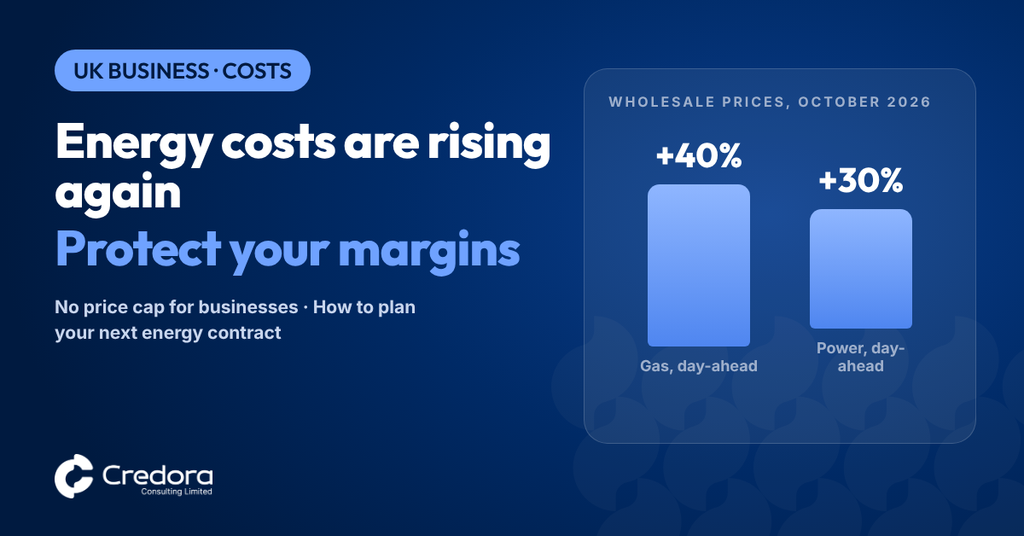
Business energy costs are rising again. Wholesale gas and electricity prices climbed sharply in October 2026 as tensions in the Middle East tightened supply, and the Bank of England expects energy to push inflation to around 5% by mid-2027. Unlike households, businesses have no price cap to protect them, so the contract you sign, and when you sign it, can make a difference of thousands of pounds a year.
This guide explains what is driving business energy costs, why so many businesses overpay, how to plan your next contract and the practical steps to protect your margins in 2027.
Key numbers at a glance
1. Why business energy costs are rising again
- Middle East tensions: disruption to shipping and energy infrastructure in the region has tightened global gas supply.
- Low gas storage: European storage went into winter less full than a year earlier, and UK storage capacity is limited.
- Tight LNG supply: liquefied gas prices stayed high over the summer, so the usual seasonal dip did not happen.
- Rising network costs: charges for using the electricity grid rose sharply from April 2026, and they now make up a large share of every bill.
2. Why business energy costs work differently
In particular, business energy works very differently from household energy:
- No price cap: suppliers set business prices, so the price you pay depends on your contract and when you agree it.
- Fixed-term contracts: most businesses sign one- to three-year contracts. The price is set at the time you sign, based on the market that day.
- Out-of-contract rates: if your contract ends and you do not renew, you can move onto much higher default rates, often around 40p per kWh for electricity compared with about 27p on a fixed deal.
- Notice periods: many contracts require written notice before they end, or they roll over automatically.
3. What makes up your business energy costs
| Part of the bill | What it covers | Can you control it? |
|---|---|---|
| Wholesale energy | The cost of the gas or electricity itself | Partly, through when and how you buy |
| Network charges | Using the national and local grids | No, but they vary by region and usage time |
| Policy costs and levies | Government schemes and the Climate Change Levy | Partly: small users may be exempt |
| Standing charge | A fixed daily charge | Compare when switching |
| VAT | Usually 20% for businesses | Low users may qualify for 5% |
4. Fixed or flexible: planning your next contract
| Fixed contract | Flexible or variable contract | |
|---|---|---|
| Price | Locked for the contract term | Moves with the market |
| Budgeting | Easier: you know your costs | Harder: costs can rise or fall |
| Risk | You may pay more if prices fall | You pay more if prices rise |
| Best for | Businesses that need certainty | Larger users with time to manage risk |
Neither option is right for every business. However, in a rising and uncertain market, many smaller businesses value the certainty of a fixed price. Whatever you choose, start the renewal process well before your contract ends, compare several quotes and read the terms for notice periods and exit fees.
5. Seven ways to manage business energy costs and protect your margins
- Know your contract end date and diary the notice deadline, so you never fall onto out-of-contract rates.
- Start renewal early: many suppliers let you agree your next contract months before the current one ends.
- Check every bill: confirm meter readings, VAT rate and Climate Change Levy are correct.
- Install a smart meter to see when and where you use energy, and cut waste.
- Invest in efficiency: LED lighting, better controls and efficient equipment can be deducted in full through the Annual Investment Allowance.
- Build energy into your budget: plan for higher costs in 2027, rather than hoping for falls.
- Review your prices: if energy is a big cost, decide now how much you can absorb and how much to pass on.
6. Support with business energy costs
- Energy-intensive manufacturers: the expanded British Industrial Competitiveness Scheme offers eligible manufacturers a discount on electricity bills. Industry reports say applications close on 30 November 2026, so check eligibility now.
- No new policy costs: the government has said it will not add new policy costs to energy bills before the 2027 spending review.
- Climate Change Levy: the main rates on electricity and LPG are due to be frozen from April 2028.
Practical scenarios
Scenario 1: The café on out-of-contract rates
A café uses 40,000 kWh of electricity a year. Its contract ended last year and it never renewed.
The result: on out-of-contract rates of about 40p per kWh, it pays about £16,000 a year for electricity units. In contrast, on a fixed deal at about 27p, it would pay about £10,800, a saving of around £5,200 a year before standing charges.
Scenario 2: The office with a contract ending in spring 2027
An accountancy practice’s fixed contract ends in March 2027.
The result: by starting the renewal now, it can compare quotes, check notice periods and decide between fixing and staying flexible, instead of renewing in a rush or rolling onto default rates.
Scenario 3: The small manufacturer
By contrast, a manufacturer with high electricity use is already on a fixed contract until 2028.
The result: its price is protected for now. However, it should check whether it qualifies for the British Industrial Competitiveness Scheme before the deadline, and plan for higher costs when its contract ends.
Frequently asked questions
Is there a price cap for business energy?
No. Ofgem’s price cap only applies to households. Instead, business prices depend on your contract and the market when you agree it.
When should I renew my business energy contract?
Start well before it ends, as many suppliers let you agree a new contract several months in advance. In addition, always check the notice period in your current contract.
Should I fix my energy price now?
It depends on your business, your budget and your appetite for risk. Fixing gives certainty, while flexible deals can benefit if prices fall. Above all, compare the full cost, including standing charges, before deciding.
Can I claim tax relief on energy-saving equipment?
Yes. Most equipment, for example LED lighting and efficient machinery, qualifies for the Annual Investment Allowance, which lets you deduct the full cost, up to £1 million a year, from your profits.
Related reading: Rates Are Up: What the Bank of England’s Rise to 4% Means for Your Business
Key takeaways
- Wholesale energy prices rose sharply in October 2026, and the market may stay tight beyond this winter.
- Business energy has no price cap, so your contract and its timing matter.
- Never let your contract lapse: out-of-contract rates can be around 50% higher than fixed deals.
- Check your bills for the right VAT rate and Climate Change Levy, especially if you are a low user.
- Build higher business energy costs into your 2027 budget and pricing now.
How Credora can help
That is why we help UK businesses of all sizes and sectors plan for rising costs:
- Budget for 2027: we build realistic energy, wage and interest costs into your budget.
- Protect your cash flow: we forecast the effect of higher bills and plan how to fund them.
- Review your pricing: we work out how much cost you can absorb and what to pass on.
- Claim the right reliefs: we make sure investment in efficient equipment is claimed in full.
- Ongoing support: as your part-time finance director (Fractional CFO), we keep your margins under review as costs change.
Book a free consultation and we will build your energy costs into your 2027 budget, check your cash flow and help you plan your next contract.
Book your free consultationOr email us at enquiries@credoraconsulting.co.uk
General information, not financial advice. This article reflects market reports and government announcements as at November 2026. Energy prices change daily, and the rates quoted are averages for illustration only. Credora Consulting is not an energy broker and does not recommend any supplier. Please take advice on your own circumstances before signing a contract.
Sources: Clear Utility Solutions, Business energy market update: November 2026; MoneySuperMarket, Business energy price trends UK 2026 (October 2026 averages); Bank of England, Monetary Policy Summary, November 2026; HM Treasury, Autumn Budget 2026; GOV.UK, VAT on fuel and power; GOV.UK, Climate Change Levy rates; GOV.UK, Claim capital allowances.