
Late payment is one of the biggest threats to a healthy business. When customers pay in 90 or 120 days, you are effectively lending them money, and with interest rates now rising, that money costs more to replace. The government plans the toughest late payment rules in more than 25 years, including a 60-day cap on most payment terms and fines for persistent late payers.
This guide explains what the proposed changes mean for your business, the rights you already have today to charge interest and compensation, and the practical steps to get paid faster now.
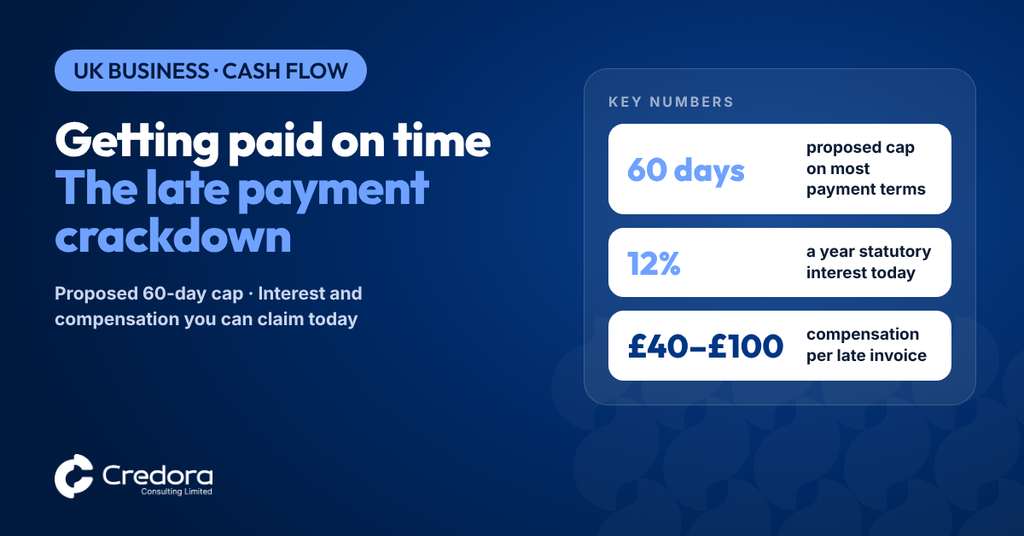
Late payment rules: key numbers at a glance
What the new late payment rules propose
The proposed Commercial Payments Bill would make major changes to how businesses pay each other. The main measures are:
| Proposal | What it would mean |
|---|---|
| 60-day cap | Most private-sector commercial contracts could not set payment terms longer than 60 days. Longer terms would be void. |
| 30-day default | Where a contract has no valid payment terms, 30 days would apply. |
| Interest you cannot contract out of | Contracts could not remove or reduce the right to statutory late payment interest of 8% above base rate. |
| Late invoice disputes | Suppliers could recover a fixed sum if a customer raises a dispute late or without proper information. |
| Stronger Small Business Commissioner | New powers to investigate poor payers, settle disputes and fine persistent late payers up to 1% of UK turnover. |
| More reporting | Large companies would report more about how they pay suppliers, including interest paid and owed. |
Your rights on late payment today
Many businesses do not realise that, under the Late Payment of Commercial Debts (Interest) Act 1998, they can already claim from business customers who pay late:
- Statutory interest: 8% above the Bank of England base rate. With the base rate at 4%, that is 12% a year.
- Fixed compensation for each late invoice: £40 for debts under £1,000, £70 for £1,000 to £9,999.99, and £100 for £10,000 or more.
- Reasonable recovery costs above the fixed sum, if your costs of chasing the debt are higher.
| Example: a £10,000 invoice paid 60 days late | Amount |
|---|---|
| Original invoice | £10,000.00 |
| Statutory interest (12% a year for 60 days) | £197.26 |
| Fixed compensation | £100.00 |
| Total you could claim | £10,297.26 |
Why the late payment rules matter more now
Every unpaid invoice is cash your business has to fund from somewhere, often an overdraft or loan. With the Bank of England base rate rising to 4% in November 2026, and the minimum wage rising in April 2027, waiting longer to be paid now costs more. Shorter payment terms protect your cash flow and reduce how much you need to borrow.
Paying suppliers? Prepare for the 60-day cap
If your business buys from smaller suppliers, the new rules could affect you too:
- Review your supplier contracts: identify any terms longer than 60 days.
- Check your payment process: make sure invoices are approved quickly, so you can pay on time.
- Plan your cash flow: paying suppliers sooner may mean you need more working capital.
- Raise disputes promptly: under the proposals, late or vague disputes could cost you a fixed sum.
How to get paid faster now
- Agree terms in writing before you start work, including the payment period and your right to statutory interest.
- Invoice promptly and accurately, with a purchase order number, due date and payment details.
- Check new customers before giving credit, and set credit limits.
- Chase early: send a reminder before the due date and follow up the day after.
- Offer easy ways to pay, such as bank transfer details on every invoice and online payment links.
- Escalate politely but firmly: state the interest and compensation due, and use the Small Business Commissioner if a large customer persistently pays late.
How the late payment rules work in practice
Scenario 1: The supplier waiting 90 days
A marketing agency supplies a large retailer on 90-day terms and invoices £15,000 a month.
The result: about £45,000 is tied up in unpaid invoices at any time. If the 60-day cap becomes law, that would fall to about £30,000, freeing around £15,000 of cash. Until then, the agency can ask for shorter terms and make clear it will apply statutory interest to late payments.
Scenario 2: The business paid 60 days late
A manufacturer invoices a customer £10,000 on 30-day terms, but is paid 60 days after the due date.
The result: under today’s rules it could claim about £197 in statutory interest plus £100 compensation, a total of about £297, without waiting for the new law.
Scenario 3: The business that pays its own suppliers late
A growing company routinely pays small suppliers in 75 days to protect its own cash.
The result: under the proposals, terms over 60 days would be void, and persistent late payment could lead to investigation and fines. Reviewing its cash flow and supplier terms now will help it adjust before the rules arrive.
Late payment rules: frequently asked questions
When will the 60-day payment cap start?
No date has been confirmed. The proposals still need to pass through Parliament and further regulations, and the government has promised a lead-in period.
Can I charge interest on late invoices now?
Yes. Under current law you can usually claim statutory interest of 8% above the base rate, plus fixed compensation, from business customers who pay late, unless your contract sets a different, substantial remedy.
Do the late payment rules apply to sales to consumers?
No. The late payment rules cover payments between businesses, and with public authorities in some cases. Sales to consumers are covered by different rules.
What is the Small Business Commissioner?
An independent body that helps small businesses with payment disputes with larger customers. Under the proposals, it would gain stronger powers to investigate and fine persistent late payers.
Related reading: Rates Are Up: What the Bank of England’s Rise to 4% Means for Your Business
Key takeaways
- The government plans to cap most payment terms at 60 days and stop contracts excluding late payment interest.
- Persistent late payers could face fines of up to 1% of UK turnover, but the rules are not law yet.
- You can already claim statutory interest (now 12% a year) and £40 to £100 compensation on late business invoices.
- Rising interest rates make late payment more expensive, so tighten your terms and credit control now.
- If you pay smaller suppliers, review your contracts and cash flow before the cap arrives.
How Credora can help you get paid on time
We help UK businesses of all sizes and sectors get paid faster and manage their cash:
- Review your terms: we check your contracts, invoices and payment terms against current and proposed rules.
- Improve credit control: we set up simple invoicing and chasing routines that get results.
- Calculate what you are owed: we work out statutory interest and compensation on overdue invoices.
- Plan your cash flow: we model the effect of shorter or longer payment terms on your cash.
- Ongoing support: as your part-time finance director (Fractional CFO), we keep your working capital under control.
Book a free consultation and we will review your payment terms, your credit control and your cash flow, so you get paid faster.
Book your free consultationOr email us at enquiries@credoraconsulting.co.uk
General information, not financial or legal advice. This article reflects the government’s proposals and the law as at November 2026. The proposed rules are not yet law and may change. Names and figures in the examples are illustrative. Please take advice on your own circumstances before acting.
Sources: Late Payment of Commercial Debts (Interest) Act 1998; Harper James, “UK late payment reforms 2026: what the new rules could mean for SMEs” (July 2026); ICAS, “UK government to introduce new laws on late payments” (March 2026); ACCA, “Time to pay up: major overhaul of UK payment practices” (March 2026); GOV.UK, Late commercial payments: charging interest and debt recovery; Bank of England, Monetary Policy Summary, November 2026.