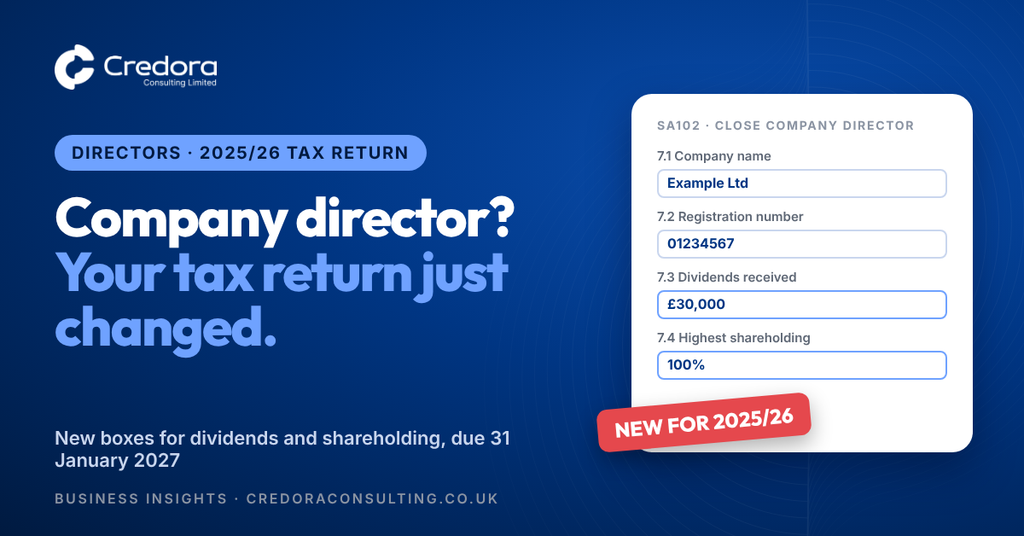
If you are a director of your own limited company, your 2025/26 tax return asks for more than ever before. For the first time, close company directors must report the company’s name and registration number, the dividends they received from it and their percentage shareholding, even where those figures are nil. The return is due online by 31 January 2027, and missing or wrong details can lead to a penalty.
This guide explains what has changed, who it applies to, exactly what to enter and the common mistakes to avoid, so your return is right first time.
Key numbers at a glance
1. What has changed for close company directors
The return has long had an optional box to say you were a director of a close company. From the 2025/26 tax year, new regulations make the director details compulsory, and add new questions about your company and your dividends.
- Before: ticking the close company director box was optional, and dividends from your own company were added to all your other dividends.
- Now: you must give the company’s details, the dividends you received from it and your shareholding, on the employment pages of your return (SA102).
2. Which close company directors are affected?
The new rules apply if both of these are true:
- You are already required to file a Self Assessment return for 2025/26. The rules do not create a new requirement to file.
- You were a director of a close company at any point in the tax year, even for part of the year.
A close company is a UK company controlled by five or fewer shareholders (participators), or by any number of shareholders who are also directors. Most family companies and owner-managed limited companies are close companies.
3. Exactly what to enter
The new boxes sit on the SA102 employment pages, alongside your directorship:
| Box | What to enter | Tips |
|---|---|---|
| 7.1 | The company’s full legal name | As shown at Companies House |
| 7.2 | The company’s registration number | The Companies House number, not your UTR |
| 7.3 | Dividends received from this company in 2025/26 | Enter 0 if none. Must match the dividends you report on the main return |
| 7.4 | Your highest percentage shareholding during the year | Based on nominal value of shares. Enter 0 if you hold no shares |
4. If you are a director of more than one company
You need a separate SA102 employment page for each close company, with the full set of new boxes completed for each one. If you hold several directorships, check that your tax software allows enough employment pages before the deadline week.
5. Common mistakes company directors make
- Leaving boxes blank when the answer is nil: HMRC expects “0”, not an empty box.
- Using the “any other information” box instead: HMRC has confirmed a note there is not acceptable.
- Mismatched dividend figures: the dividend in box 7.3 should agree with the dividend income on your main return.
- Wrong shareholding: report the highest percentage you held during the year, by nominal value, not your share at the year end.
- Missing a part-year directorship: if you were appointed or resigned during the year, the company still needs to be reported.
- Leaving it until January: gathering share and dividend records for several companies takes time.
6. What happens if you get it wrong
HMRC can charge a £60 penalty for failing to provide the new information correctly. Professional bodies report that only one £60 penalty applies per return, however many directorships are involved. This is separate from the usual penalties for filing late or paying tax late, which can be much larger.
7. The bigger picture: dividend tax
These boxes do not change how much tax you pay, but they put your dividends under closer scrutiny, and dividend tax itself has gone up:
| Dividend tax rate | 2025/26 | 2026/27 (from 6 April 2026) |
|---|---|---|
| Basic rate | 8.75% | 10.75% |
| Higher rate | 33.75% | 35.75% |
| Additional rate | 39.35% | 39.35% |
| Dividend allowance | £500 | £500 |
If you pay yourself mainly through dividends, now is a good time to review your mix of salary, dividends and pension contributions for 2026/27.
8. Your checklist before 31 January 2027
- Confirm you need to file a 2025/26 return, and list every close company you were a director of during the year.
- Gather each company’s details: full name and Companies House registration number.
- Total your dividends from each company, using dividend vouchers and board minutes.
- Check your shareholding: work out the highest percentage you held during the year.
- Complete one SA102 page per company, entering “0” where there was nothing to report.
- File and pay by 31 January 2027 to avoid late filing and late payment penalties.
Practical scenarios for close company directors
Scenario 1: The owner-director
Sarah owns 100% of her consultancy company. In 2025/26 she took a £12,570 salary and £30,000 in dividends.
The result: on her SA102 page she enters the company’s name and number, £30,000 in box 7.3 and 100% in box 7.4. The £30,000 must also appear in the dividend section of her main return.
Scenario 2: Two companies
James is a director of his trading company, where he owns 60% of the shares, and of a property company, where he owns 50%. He took dividends only from the trading company.
The result: James needs two SA102 pages. For the property company he still completes every box, entering 0 for dividends and 50% for his shareholding.
Scenario 3: The unpaid director with no shares
Amina is a director of her partner’s company but holds no shares and received no pay or dividends. She files a return because of rental income.
The result: because she already files a return, she must still complete the boxes for the company, entering 0 for dividends and 0% for her shareholding.
FAQs for close company directors
Do I have to file a tax return just because I am a director?
Not necessarily. HMRC no longer automatically requires every director to file. These new boxes only apply if you are already required to complete a return for another reason, such as dividend income above the allowance or untaxed income.
What if the company paid no dividends?
You still complete the boxes and enter 0 in the dividend box.
Does this change how much tax I pay?
No. The new boxes are for information. Your tax depends on your income as before, although dividend tax rates rose from 6 April 2026.
What is the deadline?
31 January 2027 for online returns for the 2025/26 tax year, and the same date to pay any tax due.
Related reading: How to Reduce Your Company’s Tax Bill Legally in the UK
Key takeaways
- From 2025/26, close company directors who file a return must report each company’s name, registration number, their dividends from it and their highest shareholding.
- Enter “0” where there is nothing to report. Blank boxes or notes elsewhere are not acceptable.
- Use a separate SA102 page for each close company.
- Getting it wrong can mean a £60 penalty, on top of the usual late filing penalties.
- Dividend tax rose from 6 April 2026, so review how you pay yourself for 2026/27.
How Credora helps company directors
We help company directors and owner-managers of all sizes and sectors get their tax affairs right:
- Prepare your return: we complete your 2025/26 Self Assessment, including every close company page.
- Check your records: we reconcile dividends and shareholdings against your company’s records.
- Plan your pay: we review your salary, dividend and pension mix for 2026/27.
- Keep your company compliant: accounts, corporation tax and Companies House filings handled together.
- Ongoing advice: as your part-time finance director (Fractional CFO), we keep you ahead of new reporting rules.
Book a free consultation and we will check your 2025/26 return, your dividends and your shareholding details before the 31 January deadline.
Book your free consultationOr email us at enquiries@credoraconsulting.co.uk
General information, not financial or tax advice. This article reflects HMRC requirements and guidance as at November 2026. Rules and guidance can change. Names and figures in the examples are illustrative. Please take advice on your own circumstances before filing.
Sources: The Income Tax (Additional Information to be included in Returns) Regulations 2025; Grant Thornton, “Close company directors: what’s new on your 2025/26 tax return” (October 2026); Ross Martin, “Tax return requirements for directors clarified” (September 2026); ATT, Tax return changes 2025/26: what directors need to know; ICAEW, New tax return requirements for directors cause uncertainty (May 2026); LITRG, Tax on dividends; GOV.UK, Tax on dividends.